Request a quote
Then you’ll see for yourself what you can do with a Bomech machine.
Response within 1 working day
Request a quote
Then you’ll see for yourself what you can do with a Bomech machine.
Response within 1 working day
Download productsheet
Find out which machine is best for you.
See all the specs and info about this machine
Get personal machine advice
Whether you run a farm or a contracting business, share a few details and we’ll help you choose the right setup.
See all specs and real examples of implementation
Trailing shoe or dribble bar: which one fits your land?

Sept 22, 2026
4 min
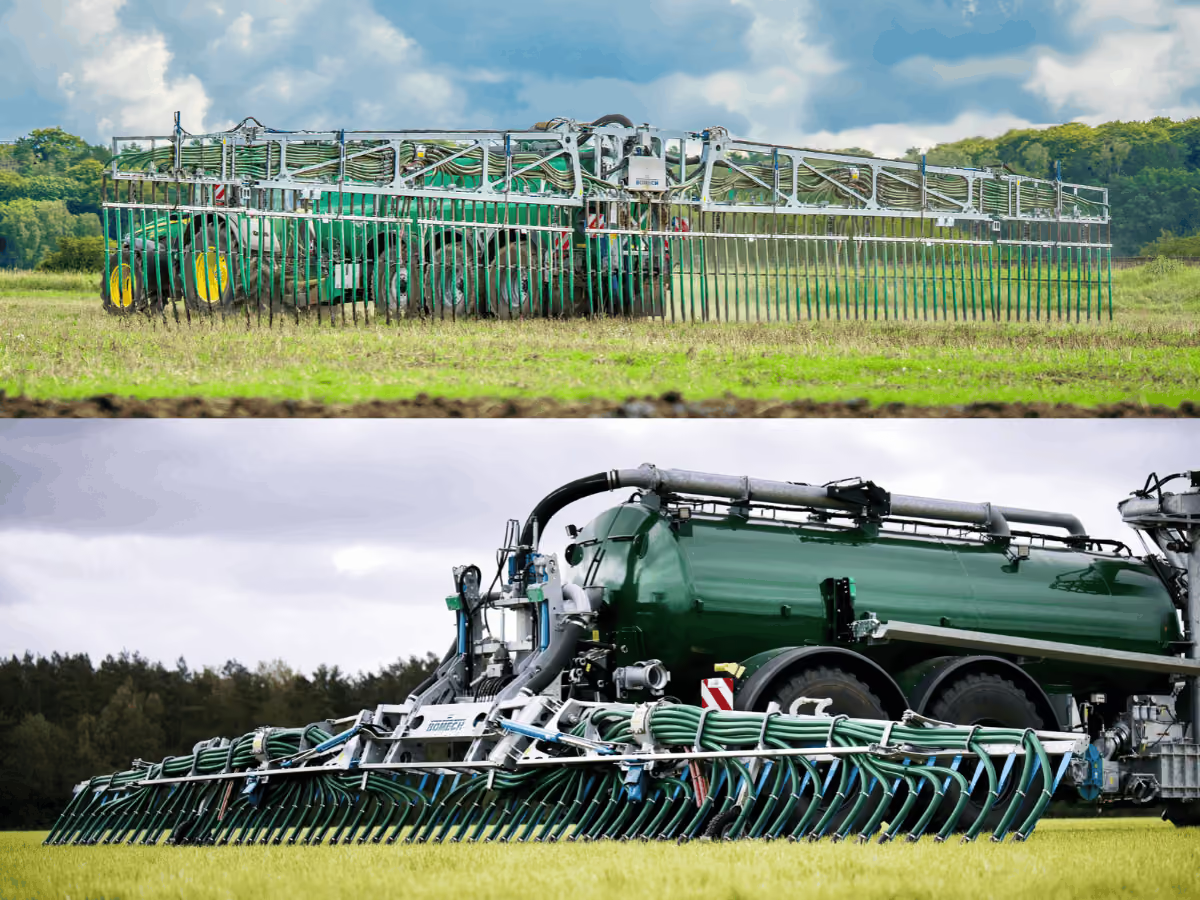
Both systems lay slurry in bands instead of spraying it across the field, and from the road they look much the same. The difference is in the last ten centimetres. A dribble bar lays the slurry on top of whatever it meets. A trailing shoe parts the crop first and places the slurry on the soil underneath it.
That one difference decides most of what follows: how much of the nitrogen you keep, how clean the crop stays and what the machine weighs.
What a dribble bar does
A dribble bar carries a row of hoses across the width of the boom and lets the slurry run out of each one. Bomech dribble bars work with a standard hose spacing of 25 cm and 50 mm outlets, in working widths up to 36 metres.
It is the simpler of the two. Fewer parts on the boom means less weight, less wear and a lower price, and the width you can reach is greater. On bare ground, on stubble and on arable land before a crop goes in, a dribble bar does the job without any of the extra machinery a trailing shoe needs.
What a trailing shoe does
A trailing shoe adds a shoe at the end of each hose. The shoe runs along the ground, pushes the crop aside, and places the slurry on the soil directly beneath it. That keeps the slurry off the leaf, which matters for two reasons: contaminated grass is less palatable and harder to ensile, and slurry lying on a leaf in the sun loses nitrogen to the air instead of putting it into the soil.
This is why the trailing shoe is the machine of choice on grassland. On a growing sward it is the difference between feeding the crop and coating it. We set out what that is worth in the advantages of a trailing shoe system.
What that means in practice
The rest of the differences follow from that one. A trailing shoe carries a shoe at every outlet, so at the same working width it is heavier on the tanker, it has more wear parts to look after, and it costs more. A dribble bar has fewer parts on the boom, stays lighter, and reaches further, up to 36 metres in our range. What it cannot do is keep the slurry off a growing crop.
Which one should you buy?
If your land is mostly grass, and especially if you cut it for silage, the trailing shoe earns its extra cost. You keep more nitrogen, the crop stays clean, and you can go on spreading later into the growing season than a dribble bar allows.
If you work mostly arable ground, spread before drilling or on stubble, or you need the widest possible boom to get through the hectares, the dribble bar is the sensible machine. You are paying for width and simplicity, and there is no sward there to protect.
If your work is split between the two, look at where the hours actually go. Contractors with a mixed round often run a trailing shoe and accept the weight, because the grassland work is where the customer sees the result.
A related system
Trailing shoes and dribble bars are both booms on the back of a slurry tanker. One other option comes up in the same conversation:
- An umbilical system pumps the slurry from the storage pit straight to the boom in the field, so there is no tanker driving over the land. Less compaction and higher capacity.
Injection goes a step further again and places the slurry in the soil rather than on it. On grassland, though, the real choice is almost always between these two.
Still not sure?
Tell us what you spread, where, and what tanker you run, and we will tell you which of our machines fits. Find your local dealer or send us your details and we will put you in touch.
Find a dealer near you
Direct technical support
Schedule a demonstration


Find your local Bomech dealer
Leave your details and we'll put you in touch with the dealer nearest to you.